
In a session
Once the stream starts you are looking at a full-bleed video of the game with no chrome around it. Everything you need is behind one keyboard shortcut.
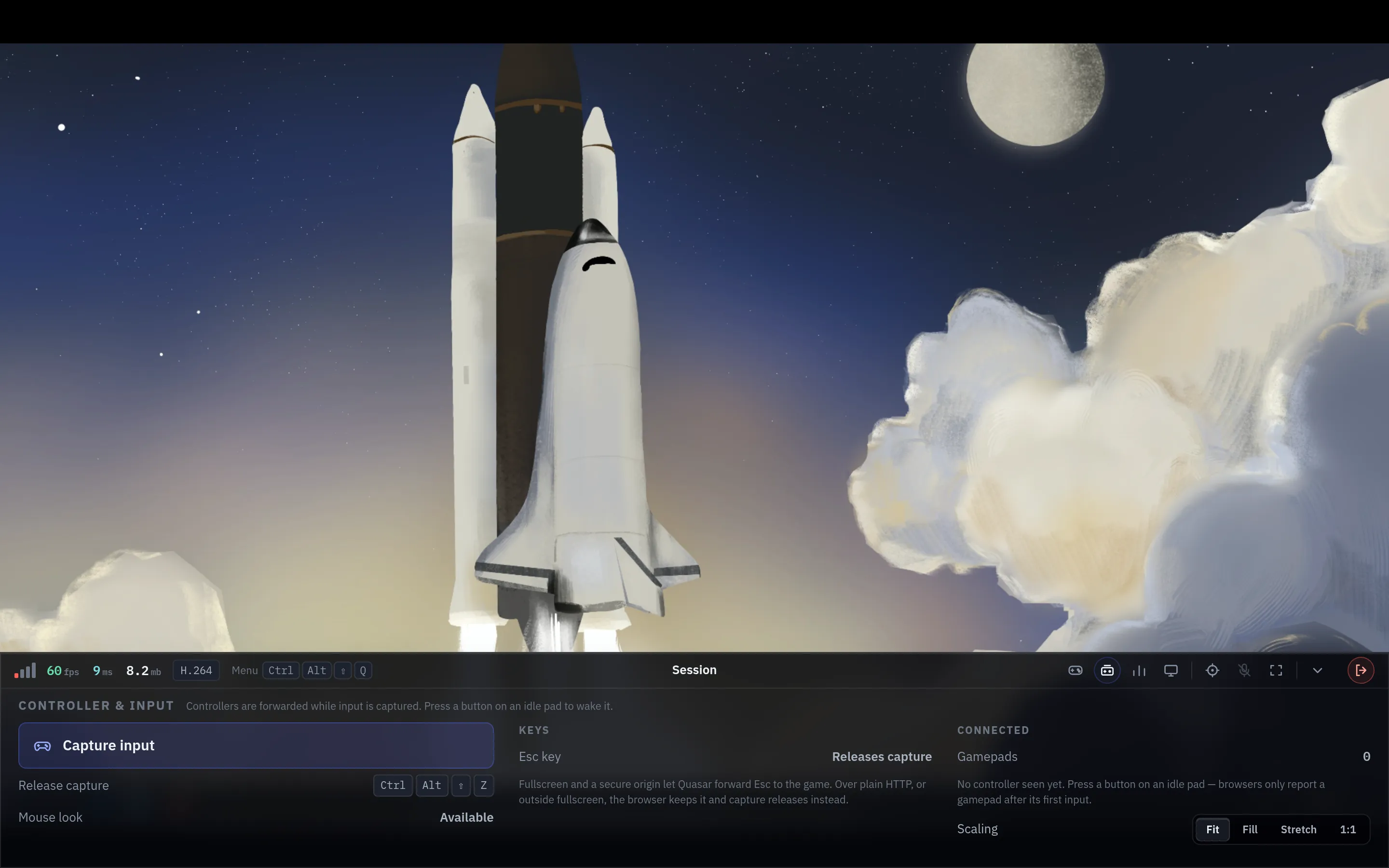
Opening the drawer
Section titled “Opening the drawer”Ctrl+Alt+Shift+Q opens and closes the session drawer. Escape closes it.
On a touch device there is a visible menu button instead, because the chord does not exist without a keyboard.
Capturing input
Section titled “Capturing input”The first thing in the drawer is Capture input. Until you capture, your mouse belongs to the browser. Once you capture, it belongs to the game and the pointer is locked.
Release it with the release combination shown in the drawer.
The Escape key
Section titled “The Escape key”Escape is awkward, because the browser wants it for leaving fullscreen and the game wants it for the pause menu.
Quasar uses the Keyboard Lock API to route Escape to the game. That needs three things at once: a Chromium-based browser, fullscreen, and a secure context (HTTPS). If any of those is missing, the drawer says so, and Escape leaves fullscreen instead of reaching the game.
If Escape is not working, check whether the page is on HTTPS first. That is almost always the reason.
Gamepads
Section titled “Gamepads”Controllers work through the browser’s Gamepad API, and the input travels over the same data channel as everything else.
Browsers only reveal a gamepad after it has sent an input, so press a button after connecting one. The drawer lists what it currently sees.
Microphone
Section titled “Microphone”If your administrator has enabled microphone capture, the drawer has a toggle for it. Three things have to line up: the instance setting has to be on, you have to turn it on, and your browser has to grant permission.
A live microphone always shows a persistent indicator. It cannot be hidden. If the microphone is on, you can see that it is on.
Microphone capture needs a secure context, so it does not work over plain HTTP.
Quick switch
Section titled “Quick switch”Swap to a different app without ending the session. The stream stays up while the new app comes in behind it. Useful for moving between a game and a desktop.
Scaling and fullscreen
Section titled “Scaling and fullscreen”Scaling controls how the stream fits your window. Fullscreen is a toggle, and it is also a precondition for Escape reaching the game.
The launch tier sets the maximum size and frame rate. During a session you can change stream resolution and render resolution independently, and adjust the interface-scale hint. Each resolution is bounded by the launch size. Returning stream resolution to the launch size releases the manual pin so an enabled ABR resolution rung can resume.
There is no manual frame-rate control. An optional ABR FPS rung can step a 120 fps session down to 60 and restore it; it is disabled by default.
Performance stats
Section titled “Performance stats”Turning on performance stats opens a diagnostics overlay and closes the drawer, so the numbers stay visible while you play.
Two of them are worth understanding.
Frame rate is what the host is producing. If this is well below your tier, the bottleneck is the host, not your network.
Presentation interval variation is how consistent the gaps between displayed frames are. This is the number that matches what stutter actually feels like. A high frame rate with high variation looks worse than a slightly lower frame rate with low variation.
See Stream quality problems for reading these properly.
Health banners
Section titled “Health banners”Quasar tells you when it thinks the stream is in trouble, then waits for you to decide. It does not silently end sessions and it does not silently retry.
| Banner | Meaning |
|---|---|
| Degrading | Quality is dropping. Usually the network. |
| Unsustainable | The stream cannot hold at this level. Consider a lower tier. |
| Not supported on your device | Your browser could not decode what was sent. |
| Reconnecting | The connection dropped and Quasar is trying to recover it. |
Not available yet
Section titled “Not available yet”Screenshot and Save last 30 seconds appear in the drawer but are disabled. They are placeholders for work that has not landed.
Ending the session
Section titled “Ending the session”Exit session in the drawer, or close the tab. Either way the container stops and your save data is written to your persistent home directory.
You get a summary afterwards: how long you played, frame rate and latency figures, and a plain-language note on how the session went.