
First-run setup
The first time you open Quasar it sends you to /setup instead of a login page,
because there is nobody to log in as yet.
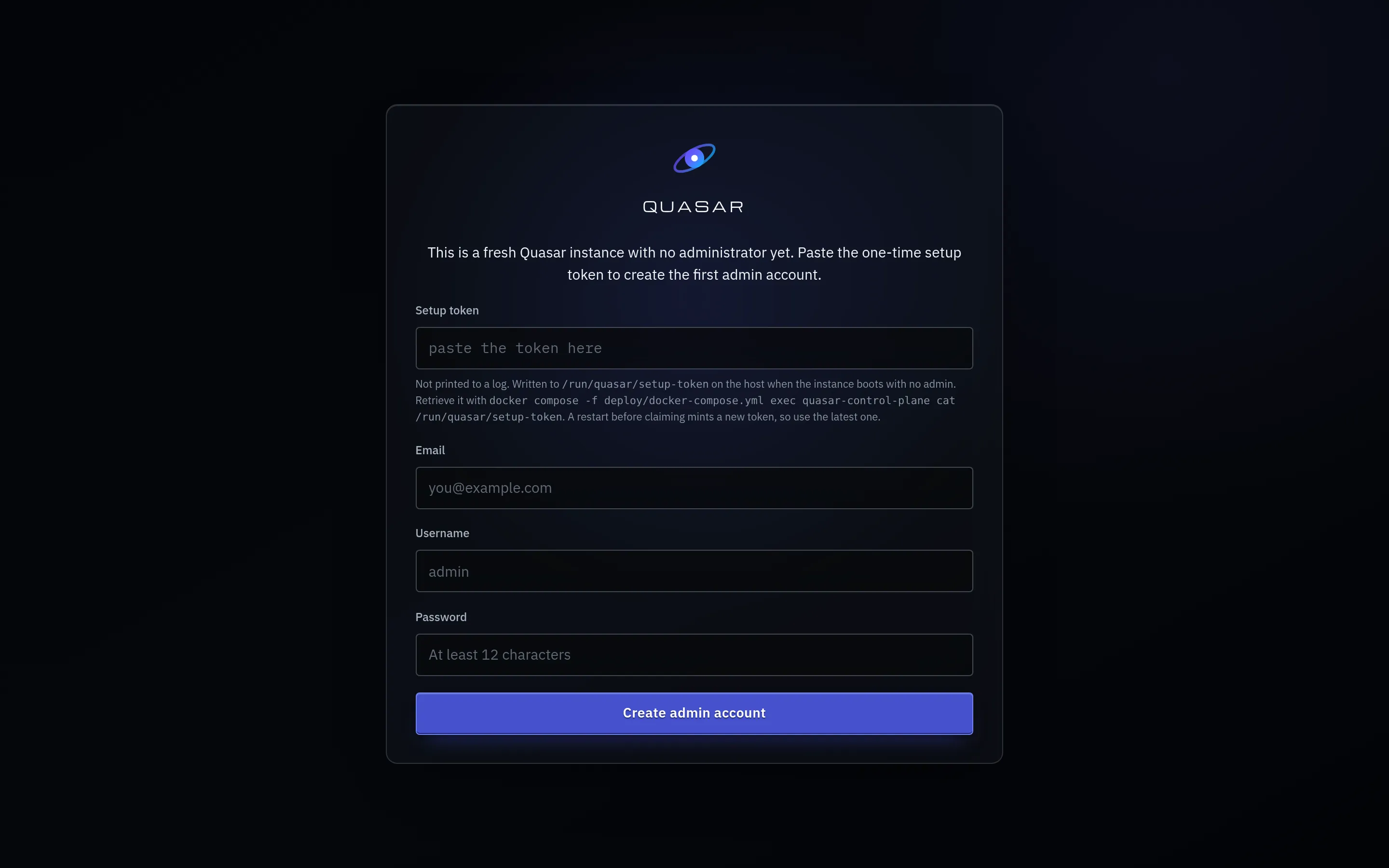
Step 1: Claim
Section titled “Step 1: Claim”The first admin account is created here, and it is protected by a one-time token so that whoever reaches the page first cannot simply make themselves the administrator of your machine.
On first boot, if no admin exists, the control plane writes a random token to a file inside the container. It is never logged and never printed. Read it with:
docker compose -f deploy/docker-compose.yml exec quasar-control-plane \ cat /run/quasar/setup-tokenPaste that into the wizard along with the email, username and password you want for the admin account.
The trust model here is simple: to claim the instance you must be able to run a command on the host. If you can do that, you already own the machine.
Or skip the wizard entirely
Section titled “Or skip the wizard entirely”If you would rather provision the admin from configuration, set all three of
these in deploy/.env before the first boot:
BOOTSTRAP_ADMIN_EMAIL=you@example.comBOOTSTRAP_ADMIN_USERNAME=youBOOTSTRAP_ADMIN_PASSWORD=a-real-passwordThe control plane creates that account at startup. It is idempotent and does nothing once an admin exists. The Claim step is then skipped.
There is no “first person to register becomes admin” path, by design. The registration endpoint can only ever create ordinary users.
Step 2: Basics
Section titled “Step 2: Basics”Set the instance name and choose how new accounts are created:
| Mode | Behaviour |
|---|---|
closed |
Nobody can register. You create accounts. This is the default. |
invite_only |
Registration works only with a valid invite code. |
open |
Anyone who can reach the page can create an account. |
You can change this later under Admin, People, Invites.
The public URL and TLS notes on this step are informational. They describe what the browser is currently seeing, they do not configure anything.
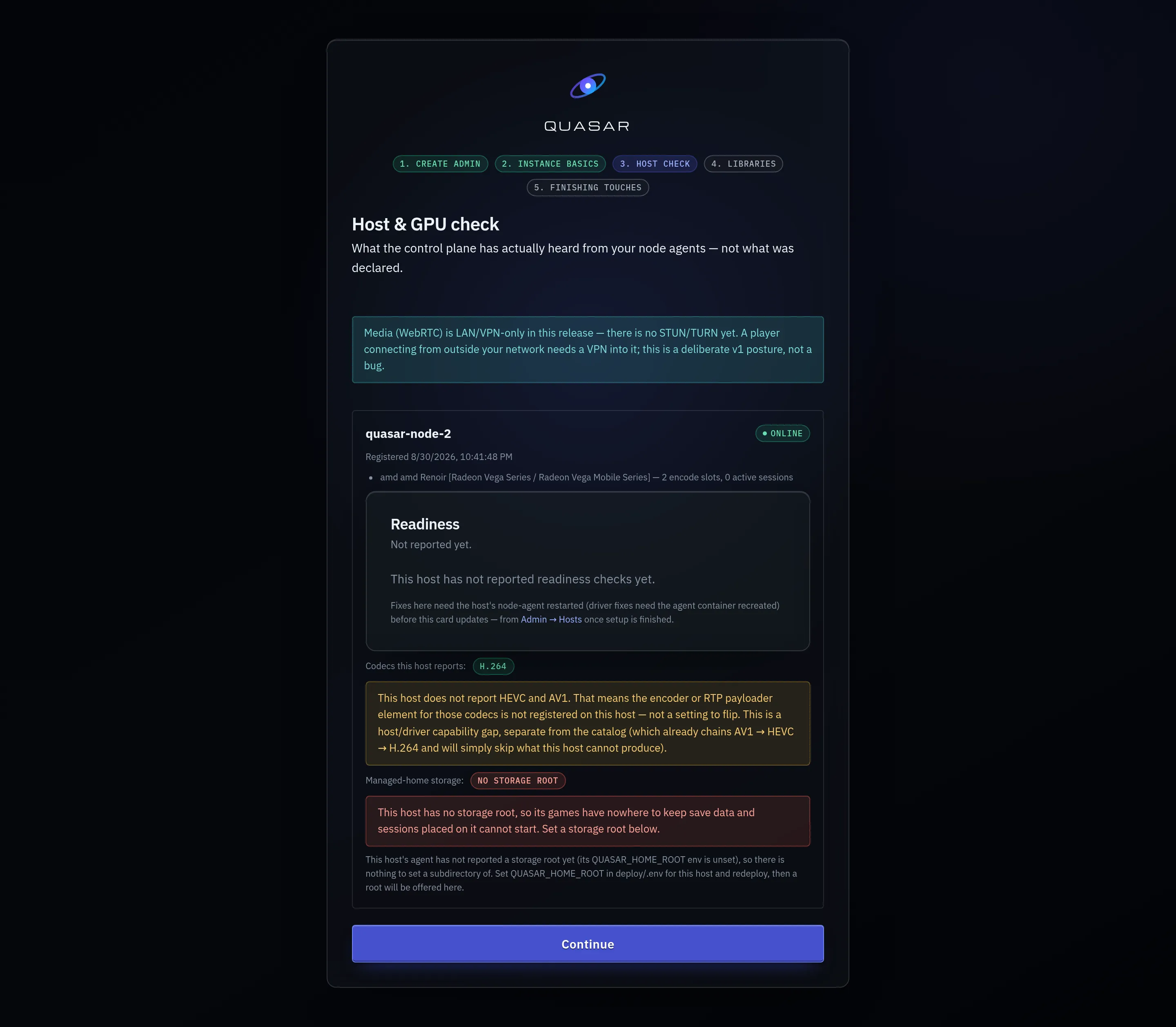
Step 3: Hosts
Section titled “Step 3: Hosts”A check of what each node agent has actually reported, as opposed to what the configuration claims, plus the managed-home root each host will use.
It tells you whether the agent registered at all, whether GPUs were found, and
whether an encoder was genuinely detected on each one. Known misconfigurations
are named directly: no encoder registered, driver components missing, /dev/uinput
not writable, input device rules absent.
Nothing here blocks you. A failing check warns and links you to Admin, Fleet,
Hosts. For storage, the wizard can keep the agent-reported root or select one of
its subdirectories. Moving to an entirely different root requires changing
QUASAR_HOME_ROOT and redeploying so the bind mount moves too.
Step 4: Libraries
Section titled “Step 4: Libraries”Turn on one or more library providers from the image catalog. Steam is the provider currently shipped by the project.
Enabling one triggers a chain on the server: its container image is installed on your hosts, a runtime preset is created from the image manifest, a launcher app is added to the catalog, and an entitlement is created according to the visibility you choose.
You choose who can see it: everyone, only you, or decide later.
The published Steam image is public. If installation fails, check the image job under Admin, Fleet, Jobs and see Images rather than assuming registry access is required.
Step 5: Finishing touches
Section titled “Step 5: Finishing touches”The last step contains optional settings that can all be changed later under Admin, Settings:
- Add a SteamGridDB API key for cover artwork.
- Enable or disable browser microphone capture.
- Start the first Steam library scan when discovery is enabled.
- Back up
deploy/.env, which contains the irreplaceableQUASAR_SECRET_KEY.
The scan is best-effort. A failed or slow scan does not trap you in the wizard; you can run it later from the administration area.
After the wizard
Section titled “After the wizard”You land in the admin area. The sensible order from here:
- Check your install actually works end to end.
- Add apps beyond whatever library discovery gave you.
- Invite people, if it is not just you.
The wizard is resumable. If you close the tab partway through, you come back to where you were.