
Apps and runtime presets
An app is a catalog entry a user can launch. It is content plus a container specification plus a launch command, not one monolithic image.
A runtime preset is a container specification several apps can share, so that a change to the base setup does not mean editing ten apps.
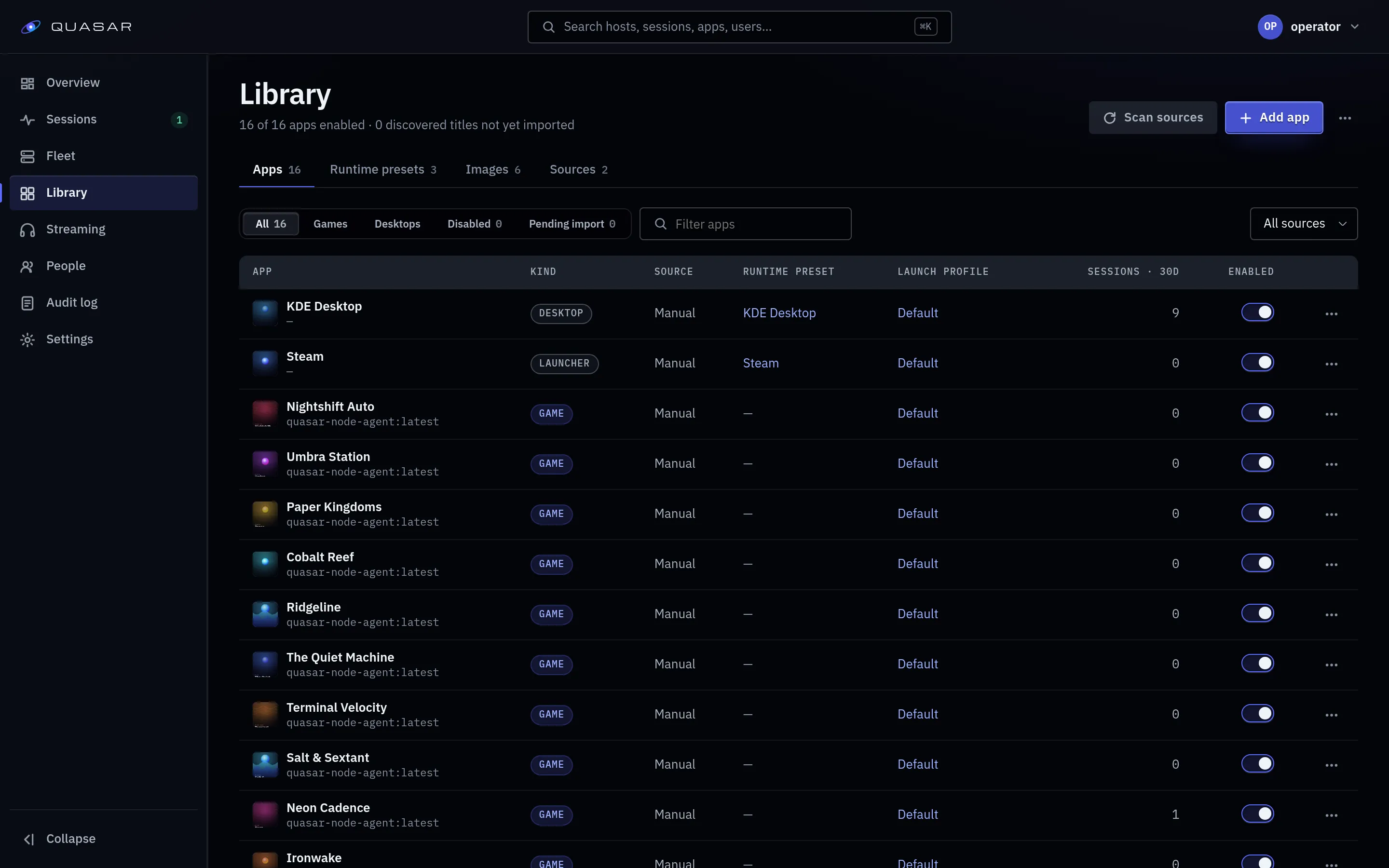
Creating an app
Section titled “Creating an app”- Install the image first, under Images. Installing it creates the runtime preset.
- Create the app and point it at that preset.
- Set the kind: game, desktop or launcher. This drives the filters users see.
- Choose which quality tiers it may launch at, if you want to restrict them.
- Grant access.
Access
Section titled “Access”An app is visible to a user only if they are entitled to it. Grant to everyone, or to named users.
This is enforced on the server, on both listing and launching. A user who is not entitled cannot see the app and cannot launch it with a direct identifier.
Library discovery creates an everyone grant automatically when it adds an app, so that discovered games are launchable without further work.
Runtime preset settings that actually matter
Section titled “Runtime preset settings that actually matter”Most defaults are fine. These four are the ones that cause problems.
Network
Section titled “Network”App containers get no network by default. That is the right default for a local game.
It is wrong for anything that needs to reach the internet. Steam is the obvious case: on first launch it downloads part of its own interface, and without network it exits cleanly and the session dies with an unhelpful message about the media path.
Set network: bridge on the preset for apps that need it. Set it per app, not
globally.
GPU access
Section titled “GPU access”The preset declares whether the container gets the GPU. Games need it. A trivial tool might not.
Environment
Section titled “Environment”Environment variables passed into the container.
Quasar injects the session’s resolution and frame rate automatically as
QUASAR_STREAM_WIDTH, QUASAR_STREAM_HEIGHT and QUASAR_STREAM_FPS, plus
GAMESCOPE_* equivalents for images that bake gamescope defaults. Without this,
an image built for 1080p60 renders at 1080p60 even when the session is 1440p120,
and the result gets upscaled into the stream, spending your bitrate on
interpolated detail.
A value you set explicitly wins over the injected one.
Exit policy
Section titled “Exit policy”What happens when the app process exits.
fail is the default and it is usually right: the app is gone, so the session
should end rather than stream a frozen frame at somebody.
keep holds the session open. Only useful for apps that legitimately come and
go.
Shared storage
Section titled “Shared storage”Each user gets a persistent home directory per app, mounted in as the app’s home. Only one session per user per app can run at a time, because two writers on the same save directory corrupts save files.
Quality tiers per app
Section titled “Quality tiers per app”You can restrict which tiers an app is allowed to launch at, which is worth doing for something that has no business running at 4K120.
The tier a session actually gets is still resolved at launch against what the host can encode and the client can decode. Restricting the list narrows the options, it does not force an outcome.
Artwork
Section titled “Artwork”If you set a SteamGridDB key under Admin, Settings, Quasar fetches artwork for catalog entries. Without one, tiles render as gradient panels. It is entirely cosmetic.