
The admin area
The admin area is at /admin, in the same web app as everything else. You reach
it if your account has the admin role.
How admin access is enforced
Section titled “How admin access is enforced”Admin is a role on your user account, checked by the server on every admin API
call. The /admin routes in the browser are hidden from non-admins purely so
they do not see a menu full of things they cannot use. That hiding is not the
security boundary. Typing the URL gets you a page that cannot load any data,
because the server refuses every request behind it.
This matters if you are evaluating Quasar: there is no client-side admin flag to flip.
The first admin is provisioned by whoever runs the host, either through the
first-run wizard’s token or through BOOTSTRAP_ADMIN_* environment variables.
Registration only ever creates ordinary users, so nobody can promote themselves
by signing up first.
The map
Section titled “The map”The admin navigation is grouped as follows.
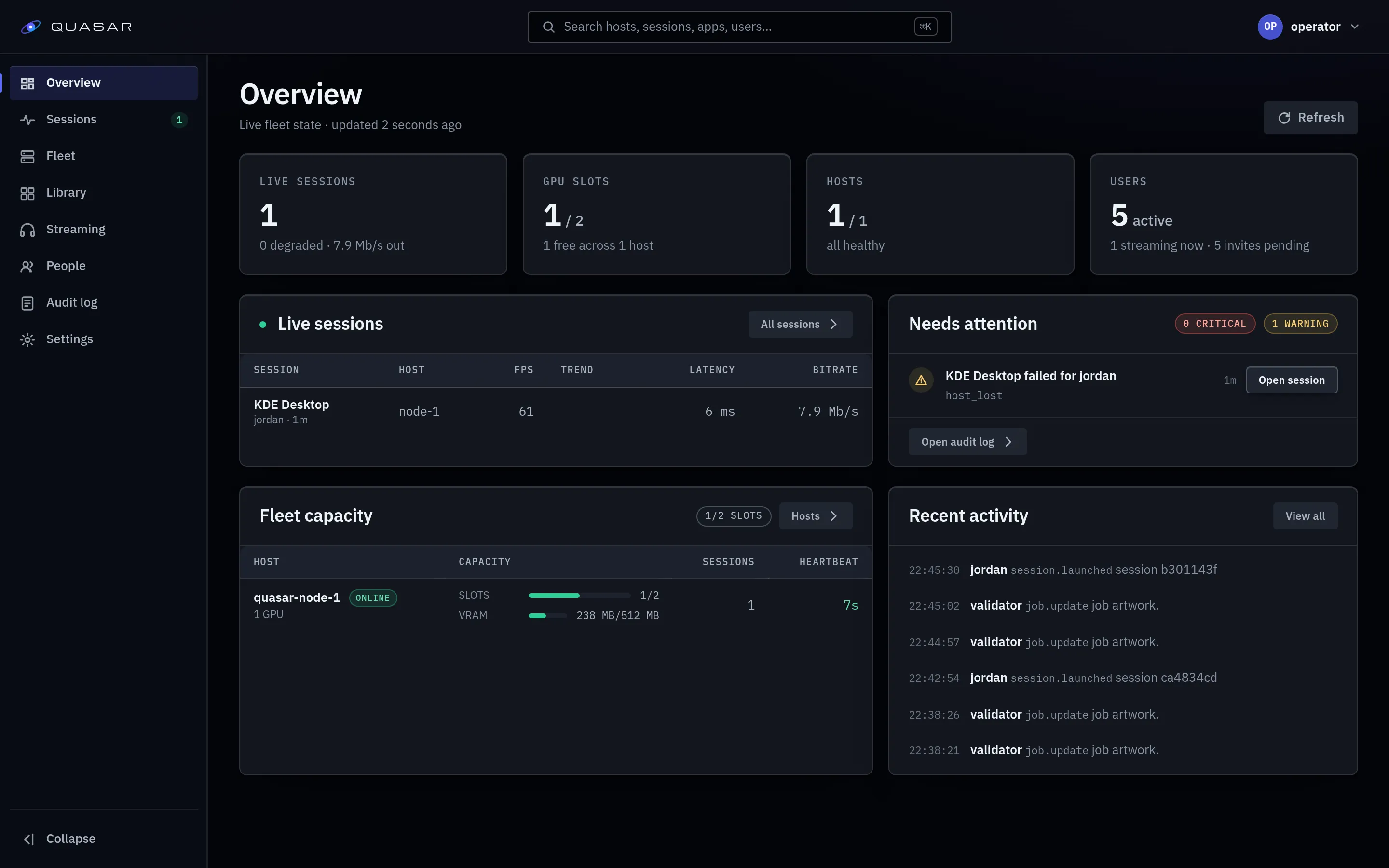
Overview is the landing page: a readiness checklist for a new instance, GPU capacity across the fleet, and recent failures.
Settings holds instance-wide configuration: registration, library discovery, allowed browser origins, artwork credentials, microphone permission, and other access settings. Per-host storage roots live under Fleet, Hosts.
Sessions is live and historical sessions, with per-session drill-down into metrics, traces and diagnostic bundles.
Audit log is a record of admin actions.
The remaining four entries are sections. Each opens on a page of tabs.
- Hosts, your GPU machines, their GPUs, capacity, per-host settings and a console.
- Storage, the managed home directories.
- Jobs, background work, schedules, run history, and run-now controls.
Library
Section titled “Library”- Apps, the catalog of things users can launch.
- Runtime presets, reusable container specifications shared between apps.
- Images, the container images installed across your hosts.
- Sources, where catalog content and cover art come from: the Steam library provider, manually defined apps, and the artwork provider.
Streaming
Section titled “Streaming”- Launch profiles, the quality tiers users pick from.
- Stream profiles, the individual encode rungs those tiers are built out of.
People
Section titled “People”- Users, accounts, roles and session limits.
- Invites, the registration mode and invite codes.
A sensible order for a new instance
Section titled “A sensible order for a new instance”- Confirm hosts and GPUs are healthy under Fleet, Hosts.
- Install the images you need under Library, Images.
- Create apps against those images under Library, Apps.
- Check the default quality tiers under Streaming, Launch profiles, and adjust if your hardware is unusual.
- Set the registration mode and invite people under People, Invites.
- Play something, then look at it under Sessions to confirm the numbers are what you expect.
What the admin area does not do
Section titled “What the admin area does not do”It does not install games. Quasar launches container images, and getting content into those images is a separate job. The Steam library provider is the closest thing to an automatic path.
It does not manage the host operating system. Drivers, kernel modules and the socket buffer sysctl are yours.