
Hosts and GPUs
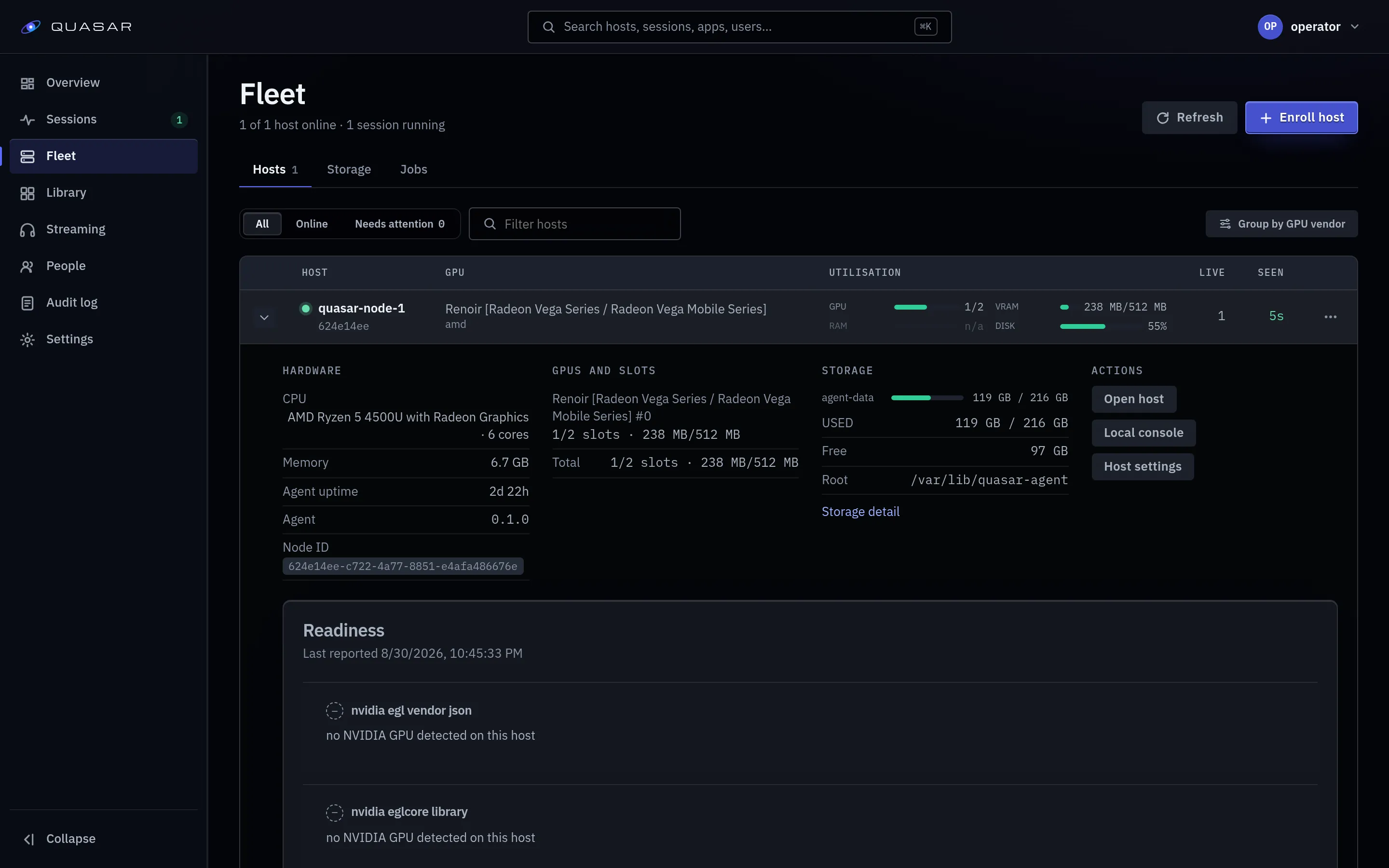
Admin, Fleet, Hosts lists every machine running a node agent, with its GPUs.
Reading a host
Section titled “Reading a host”Each host shows its status, when it last sent a heartbeat, its CPU, its storage, and a set of readiness checks.
The readiness checks are the useful part, because they report what the agent found, not what the configuration claims. The distinction matters. A host can be configured for NVENC and still have no working encoder.
Checks cover the render node, /dev/uinput write access, the managed home root,
media reachability through the host firewall, and on NVIDIA the presence of the
EGL and 32-bit GL components that a CUDA-only driver install leaves out.
A media_reachability warning names the scoped firewall rule the host is
missing. See Ports and endpoints.
GPU capacity and admission
Section titled “GPU capacity and admission”Each GPU shows its encode slots and its VRAM, used and free.
A session is admitted to a GPU when two conditions hold.
Encode slots. This is the real reservation, and it is race-safe. A GPU has a finite number of concurrent encodes it can sustain.
Free VRAM. A veto, not a reservation. If the GPU’s most recent memory sample
shows less free than QUASAR_VRAM_MIN_FREE_MB (1024 MB by default), the GPU is
skipped. Very recent launches the sample has not caught up with are debited from
the figure.
The veto abstains rather than blocking when the telemetry is missing, stale or structurally implausible. An integrated GPU whose entire memory carve-out sits below the floor would otherwise reject everything. Unknown telemetry is never allowed to reduce availability.
Set QUASAR_VRAM_MIN_FREE_MB=0 to turn the veto off and admit on slots alone.
The two capacity errors
Section titled “The two capacity errors”no_host_available means nothing in the fleet could ever serve the request.
Usually every host is offline. Retrying does not help.
capacity_exhausted means hosts are up but currently full. Retrying does help,
once something ends.
Per-host settings
Section titled “Per-host settings”Each host has a Settings page that overrides its environment configuration
without editing .env and restarting anything by hand. Precedence runs: per-host
override, then agent environment, then catalog default.
Settings come in two classes.
Live settings apply to the next session on that host. ABR mode, container knobs and most tuning are live.
Restart settings need the agent to restart, which drops any live sessions on that host. The encoder, the render node and the CUDA device are in this class. Quasar tells you before it does it.
Render node selection
Section titled “Render node selection”On a machine with more than one GPU, QUASAR_RENDER_NODE picks which one the
compositor and encoder use.
Prefer a /dev/dri/by-path/ path over /dev/dri/renderD128. The numbered names
are assigned in probe order and can move between reboots. The by-path names are
tied to the PCI address and do not.
For NVENC on a multi-GPU box, QUASAR_CUDA_DEVICE selects the CUDA device index
as well.
Placement across hosts
Section titled “Placement across hosts”QUASAR_PLACEMENT_POLICY on the control plane:
| Value | Behaviour |
|---|---|
spread |
Default. Distributes sessions across hosts. |
least-loaded |
Prefers the host with the most free capacity. |
locality |
Prefers the host that already holds the user’s home directory. |
Use locality if home directories are host-local rather than on shared storage.
Otherwise a user’s saves are on whichever host happened to run the session.
Draining and removing
Section titled “Draining and removing”Drain stops a host accepting new sessions while letting existing ones finish. Do this before maintenance.
Once it is empty, stop the agent on that machine and forget the host here.
The console
Section titled “The console”Each host has a console page for local-display mode, where the host renders to a physically attached screen rather than to a browser. It needs additional privileges and a separate compose overlay, and it is not part of the default deployment.
Storage
Section titled “Storage”Admin, Fleet, Storage shows the managed home directories across your fleet.
Each host can have its own managed-home root. It must be genuinely shared storage if you want saves to follow users between machines; otherwise use locality placement to keep a user near the host holding their files. The readiness check reports whether the root is visible and writable from the agent’s namespace.