
Images
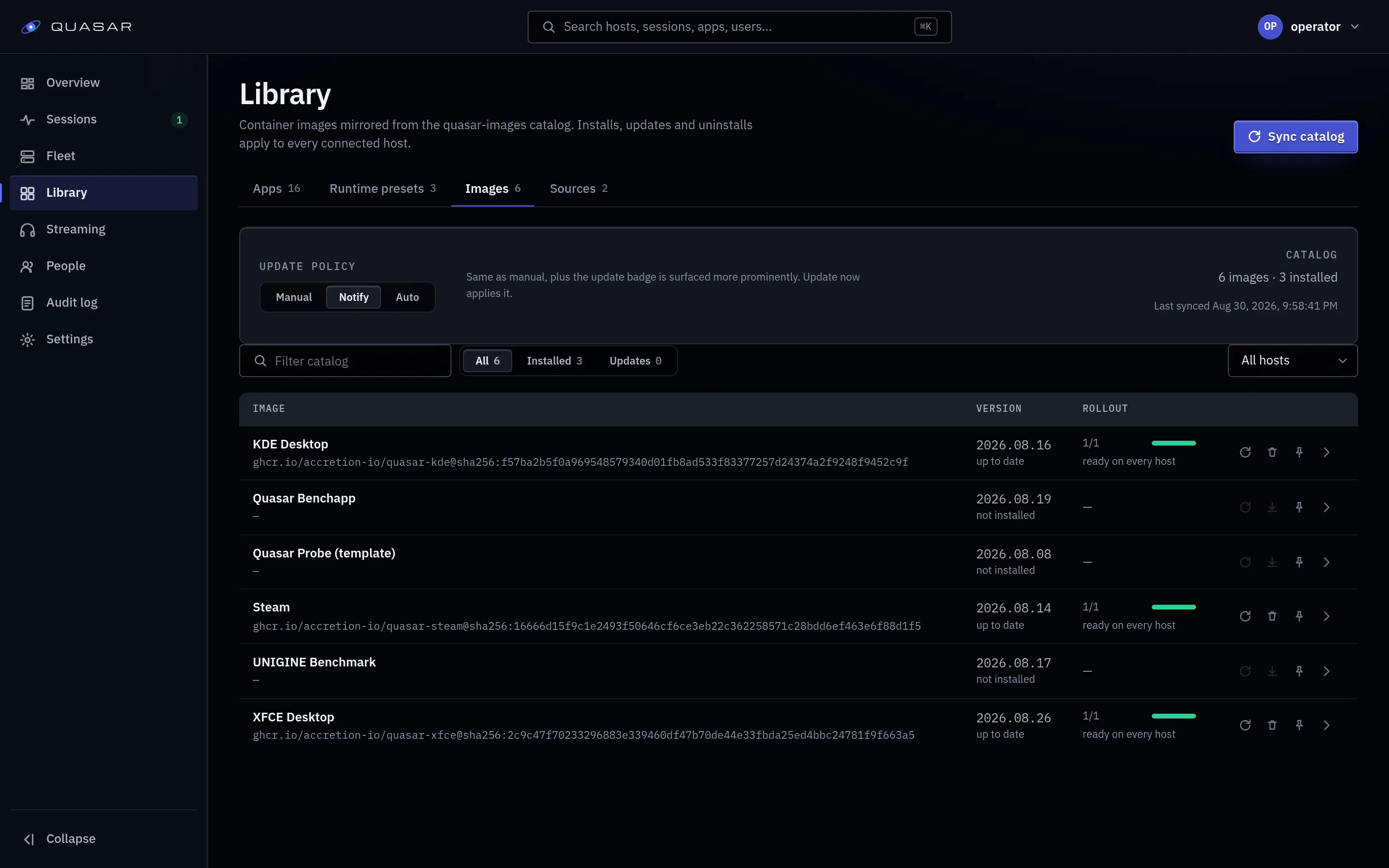
Every app runs in a container image. Admin, Library, Images is where those images are installed onto your hosts and kept up to date.
Why this exists
Section titled “Why this exists”Before it did, images were pulled by hand and referenced by tag. That had two problems worth knowing about, because they explain the design.
A tag is a moving target. Pulling :latest on host A on Tuesday and host B on
Friday can give you two different images, and the resulting difference in
behaviour is genuinely painful to track down.
Worse, a routine docker image prune deleted hand-managed app images
permanently, because there was no record of what they were or where they came
from.
So images are now a managed catalog. Quasar knows what should be installed, on which hosts, and at which exact version.
Where images come from
Section titled “Where images come from”Quasar reads a catalog manifest published by the quasar-images project. That
manifest lists the available images, what they are for, and the runtime settings
each one needs.
Entries are one of two kinds.
Prebuilt images are published to a container registry. Quasar resolves the tag to a content digest at sync time and then only ever dispatches the digest. Every host gets byte-identical bits, and a tag moving underneath you cannot change what is running.
Template images are a Dockerfile plus build arguments. The node agent downloads the build context pinned to an exact commit and builds the image locally on the host. This is behind an explicit action, not something that happens on its own.
Installing an image
Section titled “Installing an image”Install from the list. The control plane records the intent, and the node agents do the work: each host pulls or builds independently and reports back. Progress shows per host.
Installing an image also creates or updates a runtime preset from the manifest, which is the container specification (image, environment, GPU access, mounts) that apps can then reference. That is why you install an image before creating an app against it.
Where images get placed
Section titled “Where images get placed”By default every host gets every installed image, so a session can be placed anywhere without waiting for a pull.
Individual apps can opt into lazy placement instead, where the image is only fetched on the first launch attempt on that host. Worth it for large images you rarely use, at the cost of a slow first launch.
Updates
Section titled “Updates”Instance-wide policy under Admin, Settings:
| Policy | Behaviour |
|---|---|
notify |
Default. Tells you an update exists and waits. |
manual |
You update when you update. |
auto |
Updates are applied as they appear. |
Any individual image can be pinned, which holds it at its current version regardless of the policy.
Updates never disturb a running session. A new version takes effect at the next launch.
Registry allowlist
Section titled “Registry allowlist”QUASAR_IMAGE_REGISTRY_HOSTS limits which registries Quasar will resolve
digests or fetch artwork from. It defaults to ghcr.io. This is a containment
measure: it means a manifest cannot point your hosts at an arbitrary address.
Widen it only if you are publishing your own images elsewhere.
If an install stalls
Section titled “If an install stalls”Open Admin, Fleet, Jobs and inspect the image job and its most recent run. The published Steam package is public; an unresolved digest now points to registry reachability, the registry allowlist, credentials for a different registry, or a malformed image reference rather than a private upstream package.
Using your own image
Section titled “Using your own image”The image family is layered: a Fedora base, then a graphics layer carrying Vulkan, EGL, Wayland, audio and the NVIDIA runtime pieces, then app layers on top.
Every image in the app catalog must derive from the graphics layer. That is what supplies GPU access and the Wayland plumbing the compositor expects. An arbitrary image from Docker Hub will not work.
Images also carry contract labels that are validated when they enter Quasar. If you develop Quasar’s image family itself, use the canonical image build and QA workflow described in GPU and remote workflows.