
Quality profiles
There are two objects here and the distinction matters.
A stream profile is one concrete encode rung: one codec, one resolution, one frame rate, one bitrate, plus the thresholds that decide whether a given client qualifies for it. Users never see these.
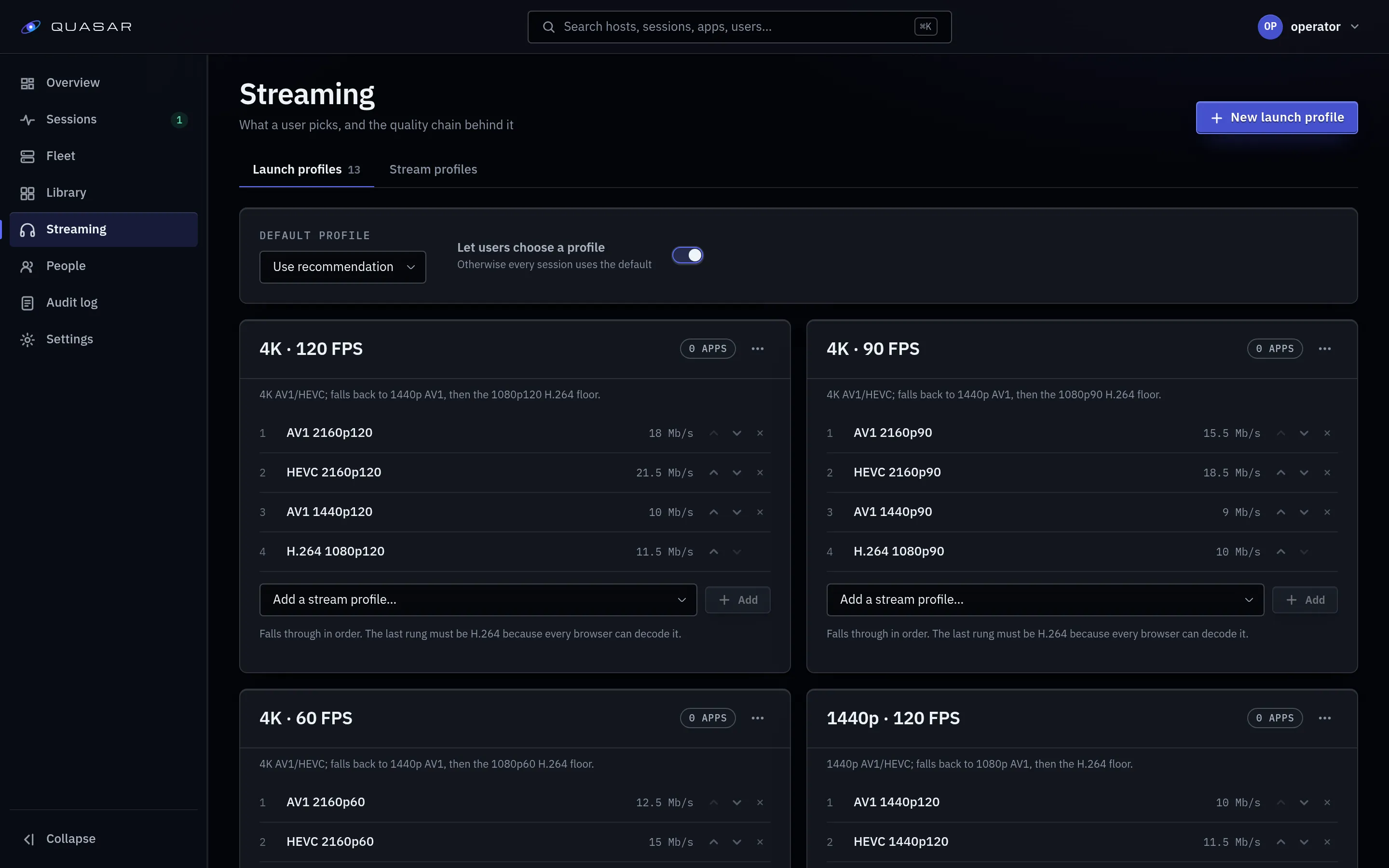
A launch profile is an ordered list of stream profiles, best first. This is what a user picks, and it is what “1080p60” means in the interface.
How a session resolves
Section titled “How a session resolves”At launch, the server walks the chosen launch profile’s rungs in order and takes the first one that survives four checks:
- The host can encode it. The placed GPU has to have that codec.
- The client can decode it. Measured when the user logged in. HEVC and AV1 are hard-gated on a positive result, because sending an undecodable codec is a black screen, not a quality drop.
- It has not failed for this client before. A codec that failed gets skipped on later launches.
- Hardware encode is available, if the rung requires it.
Every launch profile must contain at least one H.264 rung. The server rejects a profile that does not. H.264 decodes everywhere, so there is always a rung that works and a launch never fails because nothing was playable.
What ships by default
Section titled “What ships by default”Twelve launch profiles, covering 720p, 1080p, 1440p and 4K at 60, 90 and 120 frames per second. 1080p60 is the recommended default.
Within each tier the rungs are ordered AV1 first, then HEVC, then H.264. That order is deliberate:
- AV1 saves roughly 40 to 50 percent of the bitrate of H.264 at equivalent quality, and Chrome can decode it everywhere thanks to its software fallback.
- HEVC saves roughly 30 to 40 percent, but Chrome only decodes it with operating system hardware support, so macOS and Windows clients usually get it and Linux clients never do.
- H.264 works everywhere and is the floor.
The saving is bandwidth headroom, not latency. On a clean LAN with plenty of bandwidth, the codec makes very little difference to how the stream feels. On a constrained link it makes a great deal.
When to change any of this
Section titled “When to change any of this”Mostly you should not. The defaults are a reasonable ladder for common hardware.
Reasons you might:
Your GPU cannot encode something in the list. Not a problem in itself, because unsupported rungs are skipped. It is only worth editing if you want the list to reflect reality for your own clarity.
You want to cap quality. Removing high tiers or restricting apps to specific tiers is the way to stop one user occupying a whole GPU at 4K120.
Your bitrates do not suit your network. The default bitrates target a reasonable LAN. If you are streaming over a constrained link, lowering them may give better results than letting adaptive bitrate discover the ceiling on every launch.
Instance default and user override
Section titled “Instance default and user override”Under Admin you can set the instance-wide default launch profile, and whether users are allowed to override it.
If overrides are on, a user’s own default from their account page wins. If they are off, everyone gets the instance default.
What the user sees
Section titled “What the user sees”A tier name and an indication of whether it suits their device. Not the codec, not the bitrate, not the rung list. If someone asks why they got HEVC instead of AV1, the answer is in the session detail under Admin, Sessions.
Related tuning
Section titled “Related tuning”Codec behaviour and encoder selection are covered separately in Codecs and Encoders. What the stream does with bitrate once a session is running is Adaptive bitrate.